I have always loved trekking in Europe, mainly because it feels safer and far less infested with poisonous reptiles than the mountains in India. One range I kept returning to was the Tatra Mountains. The routine was simple: arrive in Zakopane, stay the night, begin early the next morning, hike up to the alpine lakes, and descend by evening.
In 2020 my friend Mathews (now Dr rer. nat. Mathews) came to visit me. He was pursuing his doctorate in Bochum, and I was in the final year of my stay in Dresden. We had been friends since our Joseph’s days, so we decided to trek the Tatras together. The Tatras offer many routes. Some are so tourist-friendly that you can go up and come down in a horse-drawn chariot. Others are far less forgiving, where a single careless step could send you down in a coffin.
We began on a quieter trail and, while admiring the breathtaking alpine lakes, made an impulsive decision. As I was preparing to return to India for good, I felt this might be my last chance to attempt Orla Perć, one of the most dangerous routes in the Tatras, where more than a hundred people have lost their lives since the twentieth century. Foolishly, and without proper preparation or equipment, we changed course, left the marked trail, and began scrambling along narrow ridges, searching for the red markings that indicate the Orla Perć route.
Eventually we reached Zawrat Pass. The proper way is to climb the pass, not to descend through it. It was already 5 p.m., darkness was closing in, and we had no tents. The decision was clear. We had to abandon our attempt on Orla Perć and turn back, descending via Zawrat pass. By the time we reached the forest near the foothills, it was pitch dark. Our phones were nearly dead, the GPS was useless, and we at all means wanted to avoid an infamous bear route. With only a small torch, we pressed on. At one point, Mathews noticed a pair of eyes watching us, but he chose not to alarm me.
Then, suddenly, we saw tiny moving lights in the distance, like ants. At once we knew it was the highway. When I saw those lights, I was overwhelmed with joy. We fixed our eyes on those lights, kept walking, and eventually made it out safely. Only at the national park exit did we notice a large hoarding warning about bears on that very route.
___________________
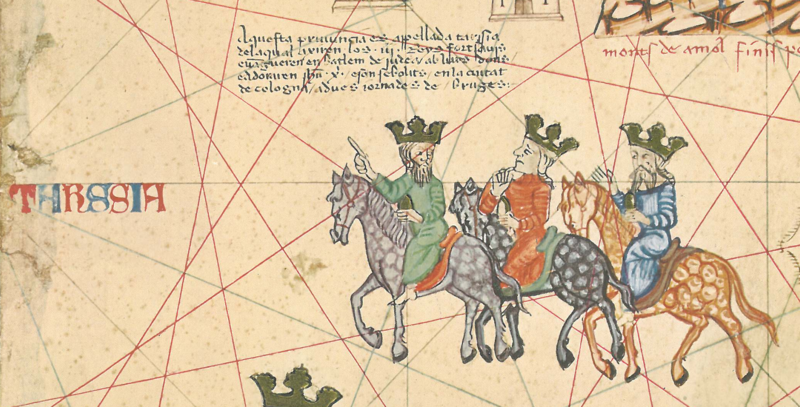
In Matthew chapter 2, we read of the Magi from the east who came to Jerusalem. These Magi were most likely eastern astrologers, members of a priestly class from Persia or Babylon. As observers of the stars, they noticed a unique sign and, through it, came to know of the birth of Jesus. The birth of Christ was such a powerful event that even those who bowed to the forces of darkness became aware that the true King had been born.
What is striking is that the Magi did not remain where they were. The moment they perceived this truth, they left their homeland and travelled to worship the King. After reaching Jerusalem, however, the Magi changed their course, choosing a far more dangerous path, one that led them straight to Herod’s palace, much like us turning towards Orla Perć.
When the Magi first perceived the truth, the star would have led them. Yet, upon arriving in Jerusalem, instead of continuing to follow the star to Bethlehem, they relied on their own understanding. They assumed that a king in Israel would be born in the capital city, Jerusalem, where the royal palace stood. Perhaps they sought direction from the people of Jerusalem, where the palace stood.
Their decision seemed rational and logical: a capital city, a royal palace, therefore a king. They did not imagine that the King would be born in Bethlehem, in a poor manger, amid the smell of animals. Such a possibility lay far outside the reasoning of these learned men.
We often make decisions in the same way. We may have begun our Christian walk with our eyes fixed on the star that God placed before us, yet at some point we begin to rely on our own logic and understanding. We stop paying attention to what God has laid upon our hearts and instead choose what appears reasonable and rational to us. As happened with the Magi, this can lead us into a palace that seems to be the right place for us, only to bring us into encounters with the most toxic, dangerous, and crafty people, much like Herod.
Look how crafty and cunning Herod was. He said to the Magi, “Go and search diligently for the child, and when you have found him, bring me word, that I too may come and worship him” (2,8). Herod could appear innocent, pious and caring, yet his true intention was not worship, but death. To the magi, Herod may have appeared outwardly as a gracious ruler, one eager to worship the true King. Yet the truth was far from this appearance. That is why, in our Christian journey, we must be cautious. Relying on our own logical thinking and judgement can often draw us towards Herod.
So who was this Herod? A brief glance at his background helps us to situate him better. Herod did not rise to power through the support of the Jewish people, but through Roman authority. Religiously, he was partly Jewish, though ethnically of mixed origin. His father, Antipater the Idumean, belonged to the Idumeans, descendants of Edom, who had been forcibly converted to Judaism about a century earlier under John Hyrcanus. His mother, Cypros, was a Nabataean Arab princess. Herod’s kingship was therefore not grounded in covenant or calling, but in political appointment. The Roman Senate, with the backing of Mark Antony and Octavian, proclaimed him “King of the Jews”.
Herod’s behaviour was marked by extreme paranoia and cruelty. Ancient sources, especially Josephus, portray him as brutally suspicious, eliminating anyone he perceived as a threat, often on mere suspicion. He ordered the execution of his own wife, Mariamne I, a Hasmonean princess whom he loved intensely yet suspected of treason. He also had his mother-in-law, Alexandra, killed. Even his own sons were not spared: Alexander and Aristobulus, sons of Mariamne, and Antipater, his firstborn son, who was executed just days before Herod’s own death. Several other relatives, including uncles, cousins, and members of the Hasmonean line, met the same fate. Emperor Augustus is reported to have remarked, “It is better to be Herod’s pig than his son.”
Now imagine the Magi arriving at such a palace and asking, “Where is he who has been born King of the Jews?” (2,2). Such a question would have struck at the very heart of Herod’s deepest fear.
Herod then cunningly summoned the chief priests and scribes and learned from the Scriptures that the Christ was to be born in Bethlehem. He sent the Magi there, instructing them to search diligently for the child and report back to him. His words suggested worship, but his intention was murder. This became tragically clear when he later ordered the killing of all the male children in Bethlehem and the surrounding region.
When the Magi left the palace and continued on their way, the star reappeared and went before them until it rested over the place where the child was.
This tells us something profound. When they relied on their own plans, the star disappeared and joy was absent. But when the star resumed leading them, joy returned. Matthew writes, “When they saw the star, they rejoiced exceedingly with great joy” (2,10). The language itself strains to express the depth of their joy, as though words were insufficient.
Did you begin your Christian journey with joy, only to lose it along the way? Have you lost sight of the star and found yourself standing in Herod’s palace instead? Perhaps you sought direction from the people of the temple city – Jerusalem, your local church or Christian mentors, and were led to the palace. Remember, God’s plan was never the Herodian palace in Jerusalem. It was a humble manger in Bethlehem, dirty and unimpressive. Yet, the peace and joy found in that Bethlehem manger is far greater than the terror and cries echoing through the palace in Jerusalem.